Beer Bottle performance depends heavily on glass bottle thickness, which directly influences mechanical strength, pressure resistance, and long-term safety during filling, transport, and storage. For breweries, packaging engineers, and quality control teams, understanding bottle thickness distribution is essential to reduce breakage, ensure compliance, and maintain consistent product quality. This article provides a comprehensive introduction to Beer Bottle glass bottle thickness, explains why thickness matters, and guides readers through practical testing methods using reliable instruments.
Why Beer Bottle Glass Bottle Thickness Matters
Beer Bottle design must withstand internal carbonation pressure, external impacts, and stacking loads during logistics. Uneven or insufficient glass bottle thickness often leads to weak points, especially at the shoulder, heel, and bottom. These areas experience the highest stress during filling and handling.
From a quality perspective, bottle thickness also affects weight control and material efficiency. Excessive thickness increases raw material costs, while insufficient thickness raises the risk of cracks or sudden failure. For this reason, breweries and bottle manufacturers closely monitor bottle thickness as a critical quality parameter.
Bottle Thickness Measurement
Accurate control of glass bottle thickness requires reliable measurement. Several technologies exist in the market, but contact-based methods remain widely adopted for routine quality checks due to their simplicity and precision.
A wall thickness tester measures the distance between the inner and outer surfaces of the bottle at specific points. By rotating or repositioning the Beer Bottle during testing, operators can evaluate thickness uniformity along the wall and bottom. This approach provides direct numerical data that supports statistical quality control and process optimization.
Compared with advanced imaging techniques such as X-ray or ultrasonic measurement, contact-based bottle thickness testing offers lower cost, easier operation, and fast results, making it ideal for production environments.
Key Testing Positions on a Beer Bottle
To understand true glass bottle thickness, testers focus on several critical areas:
- Bottle bottom: Bears vertical load and impact stress
- Heel area: A common failure point under pressure
- Sidewall: Determines overall strength and uniformity
- Shoulder and neck: Influences filling stability and capping performance
By measuring multiple points, quality teams gain a complete view of bottle thickness distribution instead of relying on a single data point.
How to Perform Beer Bottle Thickness Testing Step by Step
A standard testing process ensures consistent and reliable results:
- Place the Beer Bottle securely on the test stand of the wall thickness tester.
- Adjust the measuring probe to contact the outer surface gently.
- Align the probe with the target testing position.
- Record the digital reading for wall or bottom thickness.
- Rotate or reposition the bottle to test additional points.
- Compare results against internal specifications or industry guidelines.
This procedure helps operators identify thickness deviations early and take corrective actions.
Industries and Quality Applications
Beer Bottle glass bottle thickness testing plays a vital role in multiple industries:
- Beverage and Brewing Industry: Ensures safe carbonation and reduces breakage
- Glass Manufacturing: Supports process control and mold optimization
- Packaging Quality Inspection Agencies: Verifies compliance and batch consistency
- Research and Development: Assists in lightweight bottle design without compromising strength
Across these applications, accurate glass bottle thickness data supports safer and more sustainable packaging solutions.
Choosing the Right Wall Thickness Tester
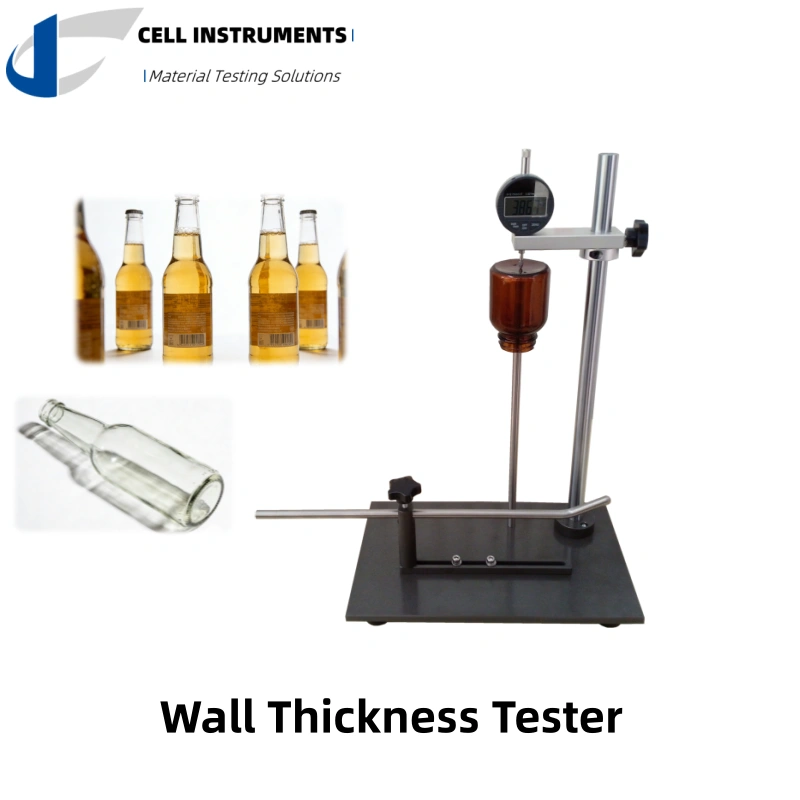
Selecting a reliable wall thickness tester directly affects testing efficiency and data accuracy. The Cell Instruments WTT-01 Wall Thickness Tester provides a practical solution for Beer Bottle thickness measurement. It supports precise digital readings, measures both wall and bottom thickness, and adapts well to containers with complex shapes.
For breweries and glass bottle producers, such an instrument improves inspection efficiency while maintaining measurement confidence. Its optional data output also helps quality teams track trends and support continuous improvement initiatives.
Conclusion
Beer Bottle glass bottle thickness represents a critical quality parameter that influences safety, performance, and cost control. By understanding glass bottle thickness, applying appropriate bottle thickness testing methods, and using a reliable wall thickness tester, manufacturers and quality professionals can significantly reduce risks and improve packaging consistency.
With practical testing solutions like the Cell Instruments WTT-01 Wall Thickness Tester, Beer Bottle thickness measurement becomes a straightforward and dependable part of modern quality control systems.
 EN
EN  AR
AR  BG
BG  CS
CS  DA
DA  DE
DE  EL
EL  ES
ES  ET
ET  FI
FI  FR
FR  HU
HU  ID
ID  IT
IT  JA
JA  KO
KO  LT
LT  LV
LV  NB
NB  NL
NL  PL
PL  PT
PT  RO
RO  RU
RU  SK
SK  SL
SL  SV
SV  TR
TR  UK
UK